High-capacity dollies, trailers, and baggage carts manufactured to premium IATA specifications to minimize ramp turnaround times.
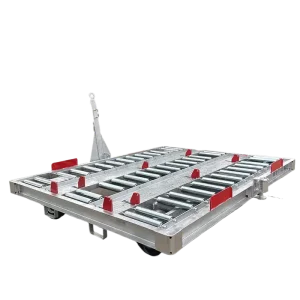
Heavy-duty 7-ton ramp pallet dolly designed for seamless transportation of LD3, LD8, and containerized cargo.
View Details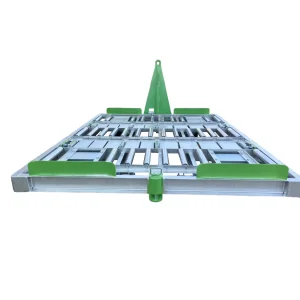
Reliable and rugged cargo ramp dollies utilizing anti-wear roller configurations and secure locking systems.
View Details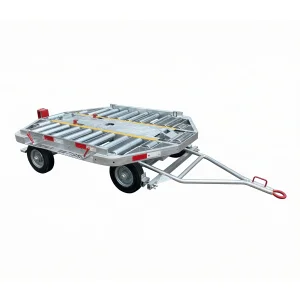
Tailored LD3 container dolly optimized for high-intensity airport logistics corridors with enhanced durability.
View Details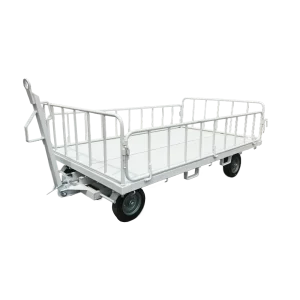
All-weather industrial baggage carts featuring specialized structural frames and responsive braking systems.
View Details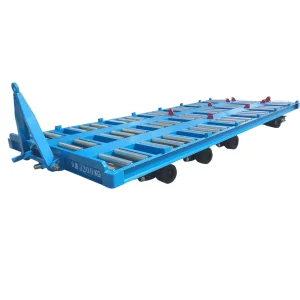
Heavy-duty transport platform engineered specifically for massive wide-body cargo operations up to 18 Tons.
View Details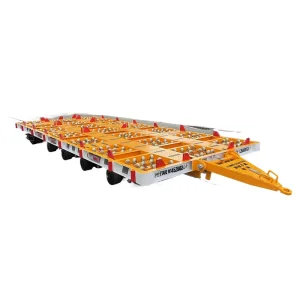
Extreme capacity 27-ton heavy-haul cargo dolly built for main-deck container configurations.
View Details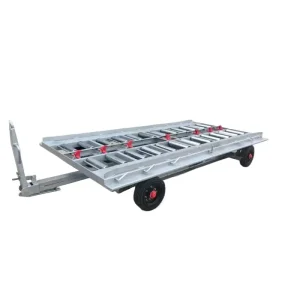
Specialized LD6 container handling unit with multidirectional cargo bed rollers for fast loading.
View Details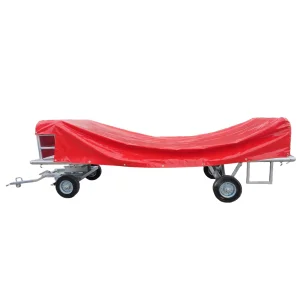
Ergonomic passenger terminal and ramp baggage trolleys utilizing heavy-duty caster sets and rust-resistant coatings.
View DetailsAnalyzing the shifts in procurement specifications, total cost of ownership (TCO), and ramp decarbonization strategies across international aviation gateways.
As aviation traffic rebounds globally, airports and ground handling agencies face intense pressure to optimize airside efficiency while transitioning to zero-emission infrastructure. The central cog in this push is the aircraft towing tractor. Modern procurement strategies have evolved beyond simple tow capacity checks; they now focus heavily on energy density, lifecycle longevity, smart fleet telematics, and compliance with the stringent safety rules outlined in the IATA Airport Handling Manual (AHM) 910/913/915.
Procuring entities in Europe and North America are prioritizing 80V and 96V Lithium Iron Phosphate (LiFePO4) systems. These units eliminate localized emissions and provide up to 70% savings in routine maintenance over legacy diesel powerplants.
Tractors must dynamically adjust torque to accommodate variations in aircraft size—from regional jets to massive wide-body frames like the Airbus A350 or Boeing 777. Smart torque vectoring prevents landing gear stress fractures.
Real-time vehicle health monitoring via CAN-bus interfaces allows fleet managers to analyze battery health, traction performance, and hydraulic pressure metrics remotely, preventing expensive ramp delays.
Customization has shifted from a premium add-on to a core operational necessity. Ground operations managers regularly negotiate tailored specifications to match localized environment constraints, such as arctic starting aids for Nordic hubs or heavy-duty HVAC cabin systems for Middle Eastern desert ramps. Consequently, choosing the right manufacturer depends heavily on their ability to build adaptable platforms without compromising structural integrity or electrical certification standards.
An aircraft tow tractor is only as effective as the surrounding ramp equipment it interfaces with. A holistically designed ramp relies on synchronized GSE systems to ensure that pushback, passenger loading, baggage transit, and refueling operate in absolute harmony to achieve the coveted sub-35-minute turnaround times for commercial narrowbody aircraft.
For instance, heavy-duty aircraft refueling trucks require precise pressure regulation systems to safely transfer volatile jet fuel into wing tanks under extreme flow rates. Concurrently, Ground Power Units (GPUs) must supply clean 400Hz electricity directly to the cockpit avionics, allowing primary engines to remain shut down during pre-flight checks. By integrating tow tractors with intelligent container dollies and baggage systems, ground operators build a unified operational web that decreases vehicle-on-ramp collision hazards and saves thousands of gallons of fuel per gate every year.
| Equipment Type | Core Functionality | Operational Optimization Area | Tractor Interoperability |
|---|---|---|---|
| Aircraft Towing Tractor (CDT Series) | Pushback & maintenance towing of commercial fleets | Gate clearance efficiency and aircraft positioning | Primary mover; dictates runway clearing speeds |
| Aircraft Tank Refueling Truck | Filtration, metering, and pressurized fuel delivery | Fast and safe refueling cycles (CD5207GJJ, CD5580GJJ) | Requires coordinated positioning during parking |
| Ground Power Unit (GPU / Solid State) | Continuous 400Hz AC and 28V DC power delivery | APU usage reduction, fuel economy, noise abatement | Often towed directly behind smaller baggage tugs |
| Air Start Unit (ASU) | High-pressure pneumatic start-up for jet turbine engines | Reliable engine crank cycles independent of onboard APU | Trailer-mounted variant towed by medium-duty tractors |
| Container & Pallet Dollies | High-capacity ULD and pallet transport across the apron | Fast luggage loading and specialized air cargo transfer | Towed in multi-car train configurations by baggage tugs |
Exploring the transition path from heavy diesel-hydraulic drivetrains to modular lithium-electric configurations, hydrogen fuel-cell range extensions, and Level 4 autonomous operations.
The ground support industry is in the midst of a generational shift. Legacy diesel systems, while powerful, face escalating emission penalties and high maintenance costs. The engineering roadmap details a transition toward three core technologies: high-voltage electric architecture, hydrogen-diesel hybrid powertrains, and autonomous steering controls.
Modern battery designs utilize active liquid thermal management. Using Lithium Iron Phosphate (LiFePO4) chemistry, custom tractors function flawlessly in temperatures ranging from -30°C to +55°C. With integrated 400V fast-charging ports, ground crews can restore up to 80% battery capacity in under 45 minutes during natural turnaround intervals, removing the need for overnight charging bottlenecks.
By combining multi-sensor fusion (comprising 3D LiDAR, stereoscopic cameras, and RTK-GNSS positioning), next-generation towbarless tractors can execute pushbacks autonomously. Pre-defined trajectories derived from real-time ATC coordinates minimize ramp accidents, which currently cost the aviation industry billions annually in airframe structural repair.
Pushing back a 250-ton aircraft generates substantial kinetic energy. Advanced regenerative braking converts this energy into electricity, sending it back to the battery pack. Meanwhile, dynamic torque vectoring distributes power to all four wheels independently, preventing wheel spin on wet or icy taxiways.
Deep manufacturing expertise meets bespoke engineering. How custom design pipelines turn unique fleet demands into battle-tested ground support machinery.
Our global commercial framework caters to tier-one airlines, dedicated cargo hubs, and international airport authorities. We bridge the gap between production capacity and customized engineering via a strict OEM and ODM service model. Every airport hub presents a unique blueprint; gradients, ramp space restrictions, and local weather patterns necessitate specific mechanical optimizations.
From initial design to final load stress tests, we customize chassis configurations, wheelbases, drawbar pull metrics, and cabin ergonomic layouts. This process ensures seamless integration with your existing fleet mechanics.
Utilizing a highly verticalized supply chain, we control raw material processing, robotic chassis welding, and final component assembly, guaranteeing on-time delivery despite global shipping volatility.
A machine is only as good as the support network behind it. We provide worldwide spare parts distribution, on-site technician training, and remote diagnostic assistance to maximize your equipment's uptime.
Our engineering pipeline integrates structural optimization tools to reduce vehicle weight without sacrificing drawbar pull. By using high-strength steel alloys in structural plates, we maintain frame rigidity while distributing weight evenly across the drive axles. The resulting vehicles deliver consistent power, minimal tyre wear, and years of trouble-free operations under heavy daily workloads.
Our manufacturing processes adhere to the highest global aviation standards, ensuring safety, reliability, and regulatory compliance on every airport ramp.
Ground support equipment must operate safely in close proximity to high-value aircraft assets. Consequently, compliance with international safety standards is our highest manufacturing priority. Every unit leaving the assembly line undergoes rigorous safety and compliance audits to certify performance under extreme load conditions.
Ensures uniform quality across design, manufacturing, assembly, and testing phases.
Guarantees full compatibility with airport safety regulations and aircraft tow interfaces.
Certifies compliance with European health, safety, and environmental protection laws.
Third-party load testing verifies structural integrity and maximum drawbar pull limits.
Our quality verification process includes ultrasonic testing of weld joints, computerized hydraulic pressure testing, and real-time pull tests on a calibrated dyno track. This guarantees that your customized towing tractor arrives fully prepared to handle the demands of heavy-duty daily pushback and towing operations.
Our engineering team answers common technical questions regarding equipment selection, operation, maintenance, and fleet optimization.
Drawbar Pull (DBP) calculation involves estimating the total force needed to overcome rolling resistance and ramp gradients. The basic formula is: DBP = W × (Cr + sinθ) + (W × a / g), where W is the Maximum Takeoff Weight (MTOW) of the aircraft, Cr is the rolling resistance coefficient (typically 0.015 to 0.02 for standard asphalt), θ is the ramp gradient angle, a is the target acceleration, and g is gravity. For example, a Boeing 737-800 with an MTOW of 79,000 kg requires a nominal tow tractor capable of generating at least 50 kN to 70 kN of constant pull under wet ramp conditions.
Electric tractors eliminate high-wear diesel components such as internal combustion cylinders, fuel injectors, turbochargers, multi-ratio transmissions, and complex exhaust treatment systems (DPF/AdBlue). This structural simplification reduces scheduled maintenance downtime by up to 60%. Additionally, the regenerative braking system handles initial slowing force, decreasing brake pad and rotor wear. With advanced Lithium Iron Phosphate (LiFePO4) battery packs, charging cycles replace costly fuel replenishment programs, resulting in a lower Total Cost of Ownership (TCO) over the vehicle's operational life.
Towbarless (TBL) tractors scoop up and lift the nose landing gear (NLG) directly onto the tractor's frame. This turns the aircraft's weight into ballast for the tractor, improving traction and eliminating the jackknifing risks associated with traditional towbars. TBL systems permit higher towing speeds (up to 25 km/h for maintenance transfers) and reduce the ground crew size required for pushbacks. Traditional towbars remain the preferred choice for long-distance maintenance towing and complex multi-aircraft configurations due to their versatility and lower initial capital cost.
For sub-zero climates, tractors require engine block pre-heaters, fuel water separators with thermal heating coils, double-pane insulated cabins, and specialized silicone hydraulic seals to prevent fluid leaks. Conversely, operations in desert climates require high-capacity tropical radiator systems, dust-proof IP65 electrical enclosures, UV-resistant wiring harnesses, and high-output air conditioning systems to maintain a safe working environment for the operator.
Modern towing tractors feature automatic safety interlock systems that communicate with the aircraft brake systems. If the pilot applies the aircraft brakes during pushback, the tractor automatically releases traction to protect the nose landing gear from structural shear stresses. Integrated load cells monitor real-time shear and torque stresses, warning the operator if parameters exceed safe manufacturer limits.
High-capacity flatbed dollies, rainproof carts, and custom airport logistics platforms designed to protect cargo integrity under heavy operations.
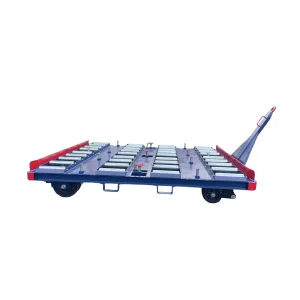
Standardized 10-foot pallet dolly equipped with heavy-duty rollers and side-loading lock points.
View Details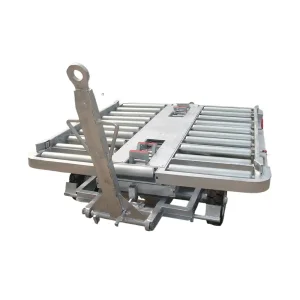
Double LD3 container dolly system designed to increase transit efficiency across airport ramps.
View Details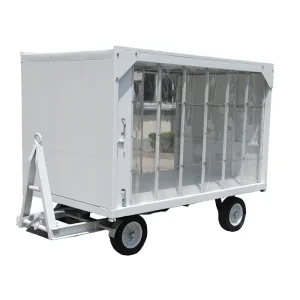
Fully enclosed cargo carts offering protection against adverse weather conditions and physical impacts.
View Details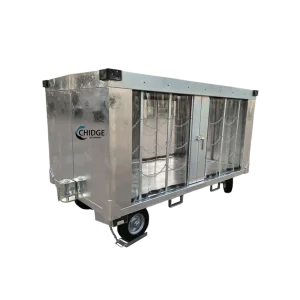
Waterproof cargo transport solutions featuring corrosion-resistant panels and secure locks.
View Details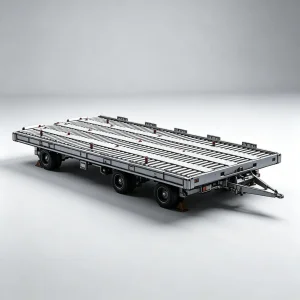
Ultra-high capacity 35-ton dolly engineered for heavy air transport systems and cargo operations.
View Details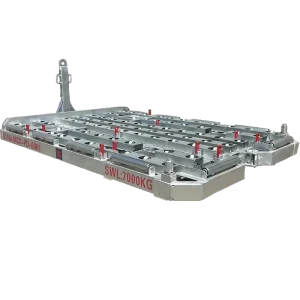
Specialized castle pallet dolly featuring a modular deck design for easy configuration.
View Details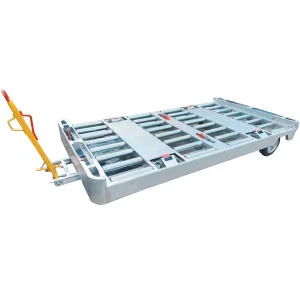
Bespoke heavy-duty container trailers designed for long-term reliability on high-load ramp routes.
View Details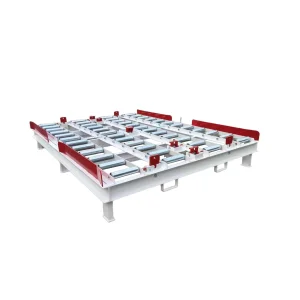
Highly maneuvrable slave pallet dollies designed for fast cargo positioning in tight warehouse terminals.
View Details Chidge Dolly